
Planning and Administering Microsoft Azure for SAP Workloads AZ-120 Exam Questions
Question #1 (Topic: demo questions)
Litware is evaluating whether to add high availability after the migration?
What should you recommend to meet the technical requirements?
Correct Answer: A
Explanation:
To meet Litware’s high-availability requirements after migration, you should recommend SAP HANA system replication combined with Azure Availability Sets. SAP HANA system replication provides real-time data replication from a primary HANA database to a secondary instance, ensuring minimal data loss and rapid failover in the event of a failure. Azure Availability Sets further enhance availability by distributing virtual machines across different fault domains and update domains, reducing the risk of downtime caused by hardware failures or planned maintenance.
To meet Litware’s high-availability requirements after migration, you should recommend SAP HANA system replication combined with Azure Availability Sets. SAP HANA system replication provides real-time data replication from a primary HANA database to a secondary instance, ensuring minimal data loss and rapid failover in the event of a failure. Azure Availability Sets further enhance availability by distributing virtual machines across different fault domains and update domains, reducing the risk of downtime caused by hardware failures or planned maintenance.
Option B only provides restart capabilities and does not offer true high availability or protection against infrastructure failures. Option C, Azure Site Recovery, is primarily a disaster recovery solution designed for site-level outages rather than high availability within the production environment. Therefore, SAP HANA system replication with Azure Availability Sets is the most appropriate solution for meeting the technical requirements.
Question #2 (Topic: demo questions)
You are evaluating which migration method Litware can implement based on the current
environment and the business goals.
Which migration method will cause the least amount of downtime?
Which migration method will cause the least amount of downtime?
Correct Answer: A
Explanation:
The SAP Database Migration Option (DMO) with System Move option of SUM, used as part of the
The SAP Database Migration Option (DMO) with System Move option of SUM, used as part of the
migration allows customer the options to perform the migration in a single step, from source system
on-premises, or to the target system residing in Microsoft Azure, minimizing overall downtime.
Reference:
https://blogs.sap.com/2017/10/05/your-sap-on-azure-part-2-dmo-with-system-move/
Question #3 (Topic: demo questions)
Answer
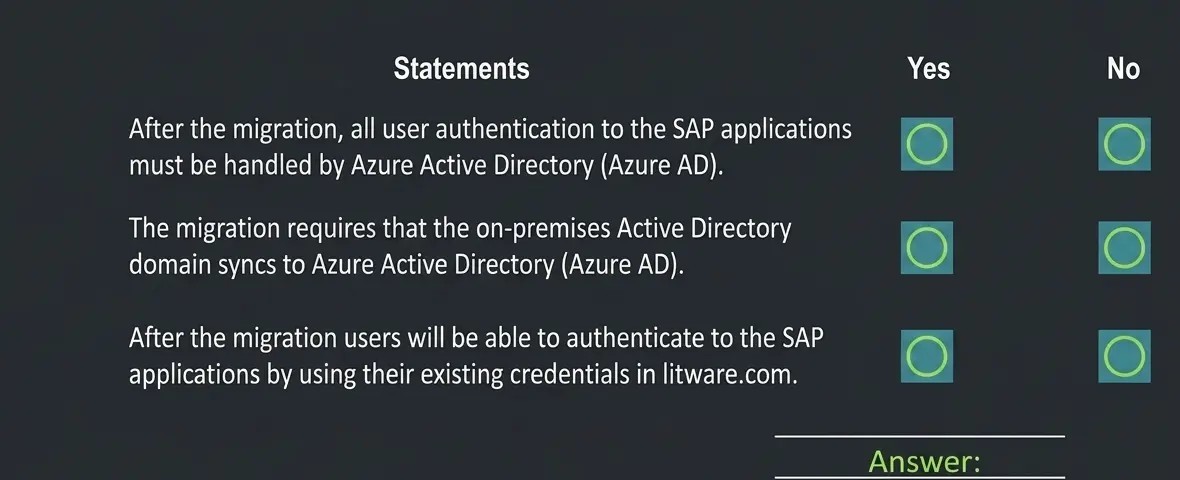
Explanation:
In a Hybrid-IT scenario, Active Directory from on-premises can be extended to serve as the
In a Hybrid-IT scenario, Active Directory from on-premises can be extended to serve as the
authentication mechanism through an Azure deployed domain controller (as well as potentially using
the integrated DNS).
It is important to distinguish between traditional Active Directory Servers and Microsoft Azure Active
Directory that provides only a subset of the traditional on-premises AD offering. This subset include
Identity and Access Management, but does not have the full AD schema or services that many 3rd
party application take advantage of. While Azure Active Directory IS a requirement to establish
authentication for the Azure virtual machines in use, and it can synchronize users with customers’
on-premises AD, the two are explicitly different and customers will likely continue to require full
Active Directory servers deployed in Microsoft Azure.
Reference:
https://www.suse.com/media/guide/sap_hana_on_azure_101.pdf
Question #4 (Topic: demo questions)
HOTSPOT
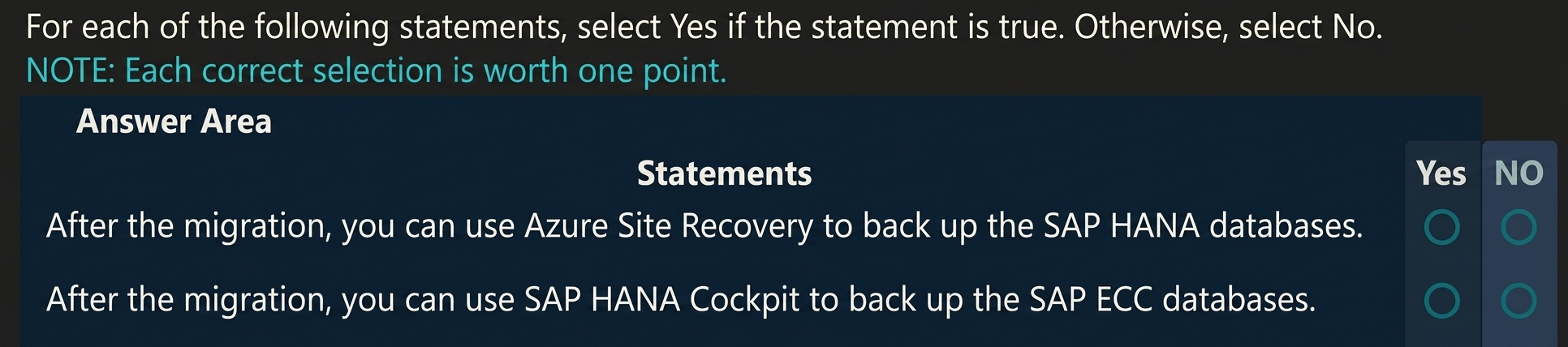
For each of the following statements, select Yes if the statement is true. Otherwise, select No.
NOTE: Each correct selection is worth one point.
Answer
Explanation:
YES
YES
YES
NO
Question #5 (Topic: demo questions)
You need to recommend a solution to reduce the cost of the SAP non-production landscapes after
the migration.
What should you include in the recommendation?
Correct Answer: C
Explanation:
To reduce the cost of SAP non-production landscapes after migration, the best recommendation is to deallocate virtual machines when they are not being used. Non-production environments such as development, testing, and quality assurance systems are often needed only during business hours. By deallocating VMs during idle periods, organizations stop paying for compute resources while retaining the virtual machine configuration and storage. This can significantly lower Azure operating costs without affecting the production environment.