Microsoft AI-103 - Developing AI Apps and Agents on Azure Certification Exam
Question #1 (Topic: demo questions)
You need to recommend a solution to support the planned changes and technical requirements for Agent1 to use the product information stored in storage1. What should you include in the recommendation?
Correct Answer: A
Explanation:
The correct recommendation is Azure AI Search. The case study states that the product detail sheets are stored as PDFs in storage1, and that Agent1 must be enabled to retrieve and use detailed product information from those sheets. It also specifies that the indexing pipeline must enable semantic and vector search, and that Agent1 must answer natural language questions about product details by using the product sheet information. Azure AI Search is the Azure service designed to ingest content from sources such as Azure Blob Storage, create searchable indexes, and support keyword, semantic, hybrid, and vector retrieval for Retrieval Augmented Generation (RAG) solutions. Microsoft’s Azure AI Search guidance states that integrated vectorization can chunk content and generate embeddings during indexing, enabling vector search over source documents. It also states that Azure AI Search supports text and vector queries and can improve raw content for search- related scenarios through enrichment pipelines. Azure Translator is unrelated to retrieval. Document Intelligence can extract document structure, but it is not the retrieval index for Agent1. Grounding with Bing Search retrieves public web content, not Contoso’s private PDFs in storage1. Reference topics: Azure AI Search, RAG, semantic search, vector search, Azure Blob Storage indexing, and agent grounding.
Question #2 (Topic: demo questions)
You need to recommend an invoice review solution that resolves the issue reported by the finance department. What should you include in the recommendation?
Correct Answer: A
Explanation:
The correct recommendation is Azure Content Understanding in Foundry Tools. The case study states that Contoso’s finance department must manually review vendor invoices to verify that invoice details match vendor contract terms, and that the invoices contain tables, logos, and varied layouts that make consistent processing difficult. It also states that the planned solution must evaluate both the visual layout and textual content of the invoices. Azure Content Understanding is designed for this type of multimodal document-processing workload. Microsoft describes Content Understanding as a Foundry Tool that processes unstructured and multimodal content, including documents and images, and transforms it into structured output for AI applications. It can use document analyzers to extract text, layout, tables, fields, and relationships from diverse document types. Chat completions alone would not reliably extract structured invoice fields from complex layouts. Azure Document Intelligence can extract OCR, layout, and tables, but Content Understanding is the better end-to-end Foundry capability for combining visual and textual understanding with structured extraction for downstream verification. Image Analysis focuses on image-level visual features and is insufficient for invoice field and table review. Reference topics: Content Understanding, document analyzers, multimodal extraction, invoice processing, tables, layout, and structured JSON output
Question #3 (Topic: demo questions)
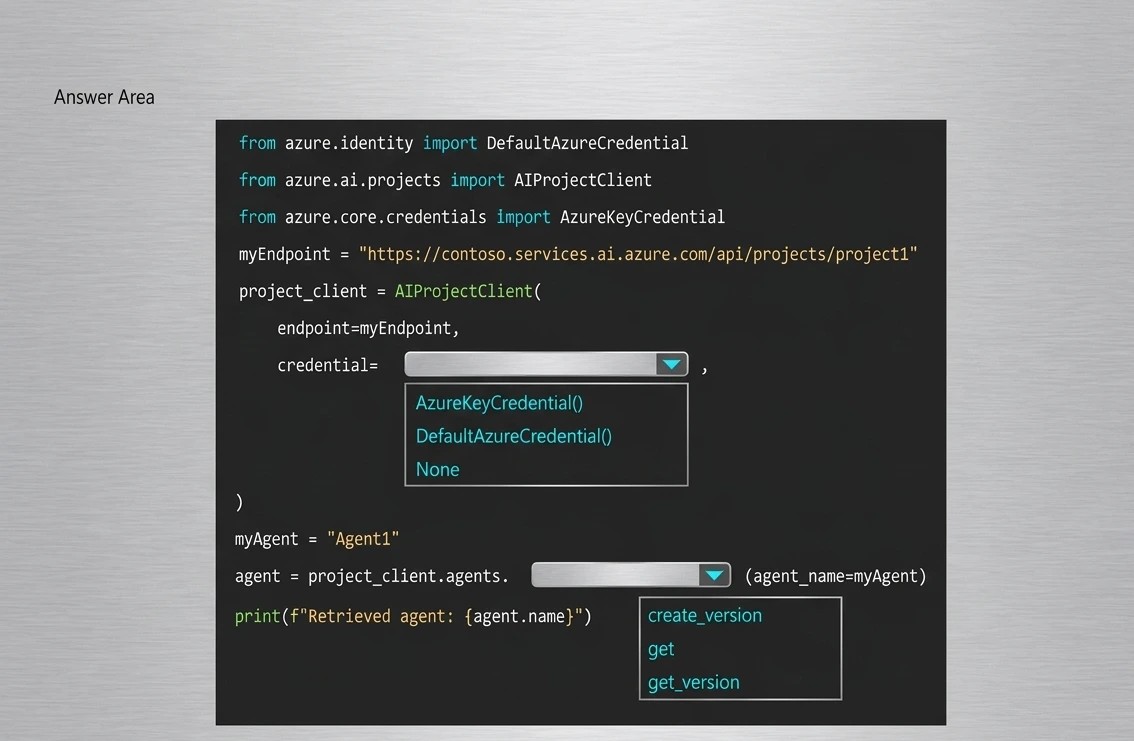
You need to ensure that Agent1Dev Team can access Agent1. The solution must meet the security and compliance requirements. How should you complete the Python code? To answer, select the appropriate options in the answer area. NOTE: Each correct selection is worth one point.
A.
Correct Answer: A
Explanation:
credential = DefaultAzureCredential() agent = project_client.agents.get(agent_name=myAgent) The correct authentication option is DefaultAzureCredential() because the case study states that API keys must not be used to access Foundry-deployed models and that Contoso developers must authenticate to Microsoft Foundry resources by using Microsoft Entra authentication. It also states that access to Project1 must be assigned to Agent1Dev Team by using the security group SC_Agent1_Dev. Microsoft Foundry authentication guidance recommends Microsoft Entra ID for production workloads because it supports least-privilege RBAC, per-principal auditing, and keyless authentication. AzureKeyCredential() would violate the no-API-key requirement, and None would not provide a valid credential. The correct agent operation is get because the task is to access an existing agent named Agent1, not create a new version or retrieve a specific published version. Microsoft Foundry SDK examples show AIProjectClient created with DefaultAzureCredential() and then using project agent operations to create, retrieve, or interact with agents by name. To meet the compliance requirement, the group SC_Agent1_Dev must also be granted the appropriate project-scoped Foundry role, such as Foundry User, for Project1. Reference topics: Microsoft Entra authentication, Foundry RBAC, AIProjectClient, and project agent access.
Question #4 (Topic: demo questions)
You need to configure Agent1 to answer customer questions about only the Contoso products. The solution must meet the business requirements. What should you do?
Correct Answer: B
Explanation:
The correct answer is B. Modify the system message instructions. The case study states that Agent1 answers general questions about Contoso products and that a business requirement is for Agent1 to answer questions only about products sold by Contoso. This requirement defines the agent’s allowed domain and refusal boundary, so it must be expressed in the agent’s system-level instructions. Microsoft Foundry guidance states that system messages steer Azure OpenAI chat model behavior and are used to define the assistant’s role, boundaries, output format, and safety or quality constraints. The system message should instruct Agent1 to answer only Contoso-product questions, use Contoso product documentation when available, and decline questions about non-Contoso products. This directly enforces the intended business scope at the highest instruction level. Few-shot examples can reinforce desired behavior but are not the primary control for defining mandatory operating boundaries. Top-p sampling and temperature are decoding controls; they influence randomness and diversity, not whether the agent restricts answers to a specific product domain. Increasing temperature would likely reduce consistency. Reference topics: Microsoft Foundry agent instructions, system message design, prompt engineering, response boundaries, and grounded generative AI behavior.
Question #5 (Topic: demo questions)
You need to configure Agent1 to answer customer questions about only the Contoso products. The solution must meet the business requirements. What should you do
Correct Answer: B
Explanation: