Microsoft AI-200 - Developing AI Cloud Solutions on Azure Certification Exam
Question #1 (Topic: demo questions)
DRAG DROP You are designing a document ingestion pipeline for an AI application. Documents are uploaded by users and must be converted into searchable vector content. Arrange the steps in the correct order
A.
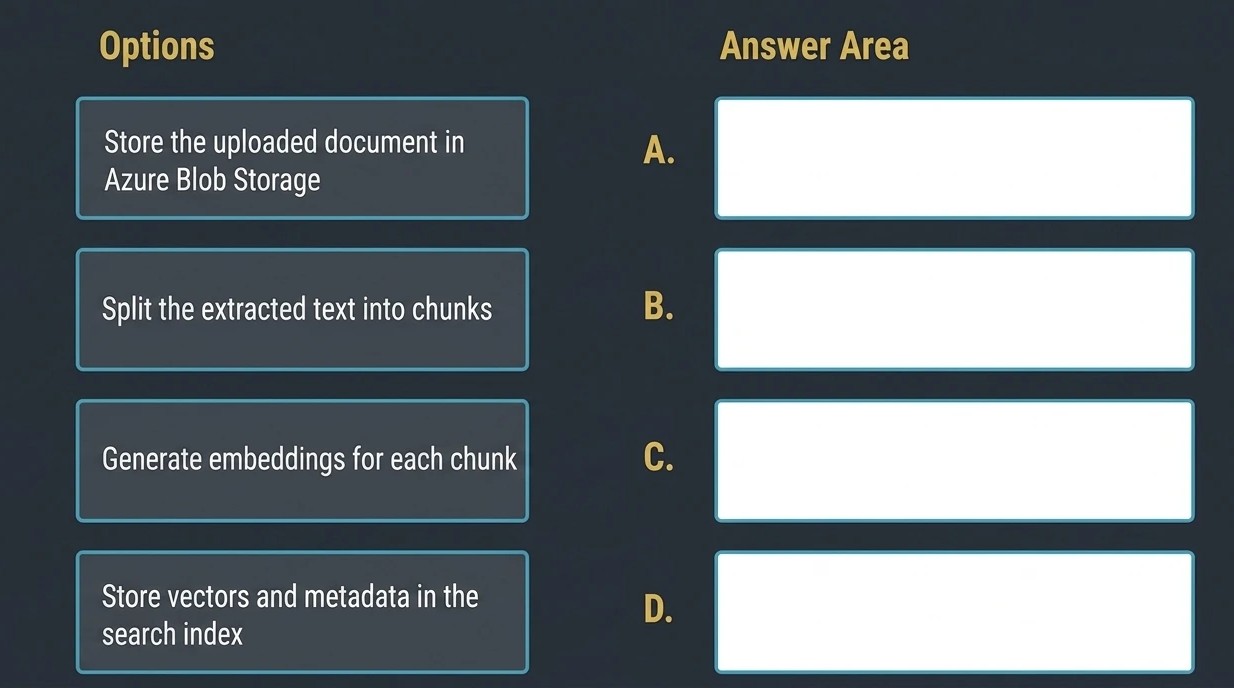
A. Store vectors and metadata in the search index
B. Generate embeddings for each chunk
C. Store the uploaded document in Azure Blob Storage
D. Split the extracted text into chunks
Correct Answer: A
Explanation:
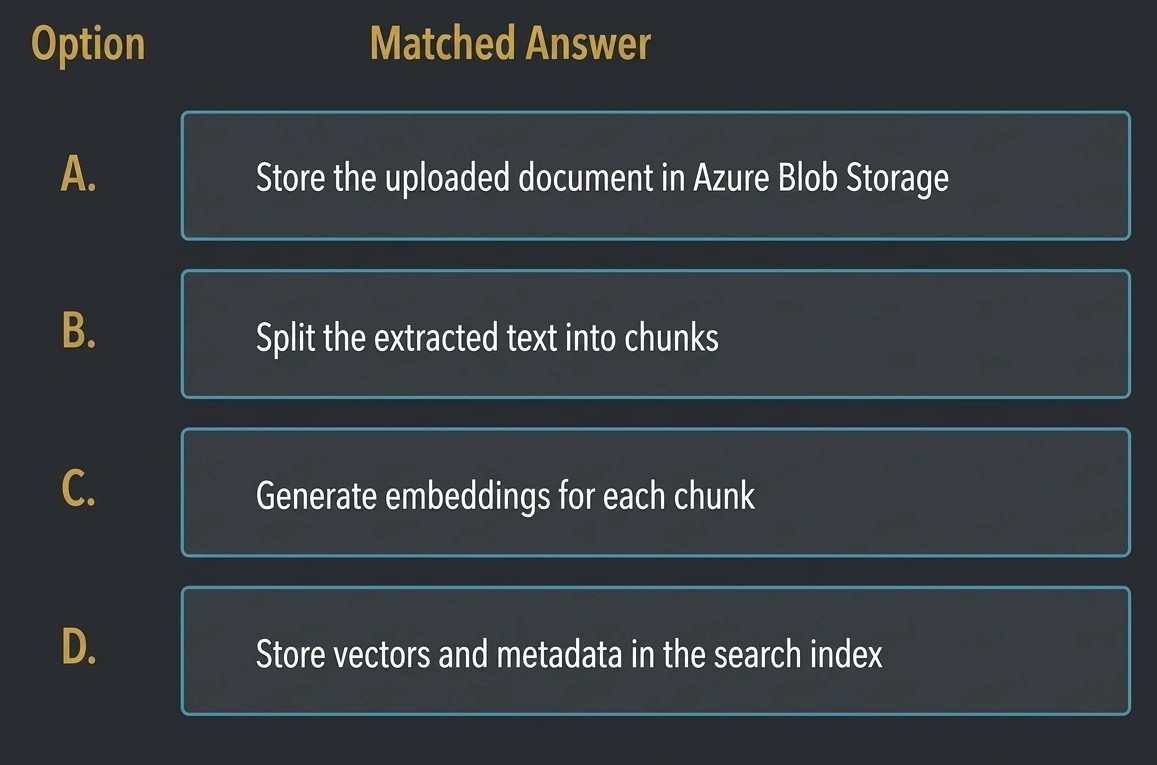
The document must first be stored in a durable location such as Azure Blob Storage. After the content is available, the text can be extracted and split into smaller chunks. Embeddings are generated for each chunk so semantic similarity search can be performed. Finally, the vectors and metadata are stored in a vector-enabled index or database for retrieval during AI application execution.
Question #2 (Topic: demo questions)
You are deploying a containerized Python AI application to Azure Container Apps. The application image is stored in Azure Container Registry. The deployment fails because the container app cannot pull the image. What should you configure?
Correct Answer: B
Explanation:
When Azure Container Apps pulls an image from Azure Container Registry, it needs permission to access the registry. This can be done by configuring registry credentials or using a managed identity with the appropriate pull permission. Without image pull access, the container app cannot download the image and the deployment fails.
Question #3 (Topic: demo questions)
You are designing an AI cloud solution that uses Azure SDKs. Match each requirement to the best practice
Correct Answer: A
Explanation:
Modern Azure SDK development follows several important best practices for security, reliability, and
Modern Azure SDK development follows several important best practices for security, reliability, and
performance. Applications should avoid storing credentials directly in code and instead use managed identities or Azure Key Vault for secure secret management. Temporary network or service interruptions are common in distributed cloud environments, so retry policies with exponential backoff help applications recover automatically from transient failures. Reusing SDK client objects improves connection management, reduces resource consumption, and increases overall application efficiency. Structured logging and telemetry provide visibility into application behavior, making it easier to diagnose failures, monitor performance, and troubleshoot issues across multiple Azure services and distributed AI workloads.
Question #4 (Topic: demo questions)
You are developing an AI cloud solution on Azure. The solution includes a Python API that receives user requests and sends long-running AI jobs to a background processor. You need to ensure that the API responds quickly and that failed jobs can be retried. Which Azure service should you use between the API and the worker?
Correct Answer: A, B, C, D
Explanation: