Microsoft AB-900 - Microsoft 365 Copilot and Agent Administration Fundamentals (beta) Certification Exam
Question #1 (Topic: demo questions)
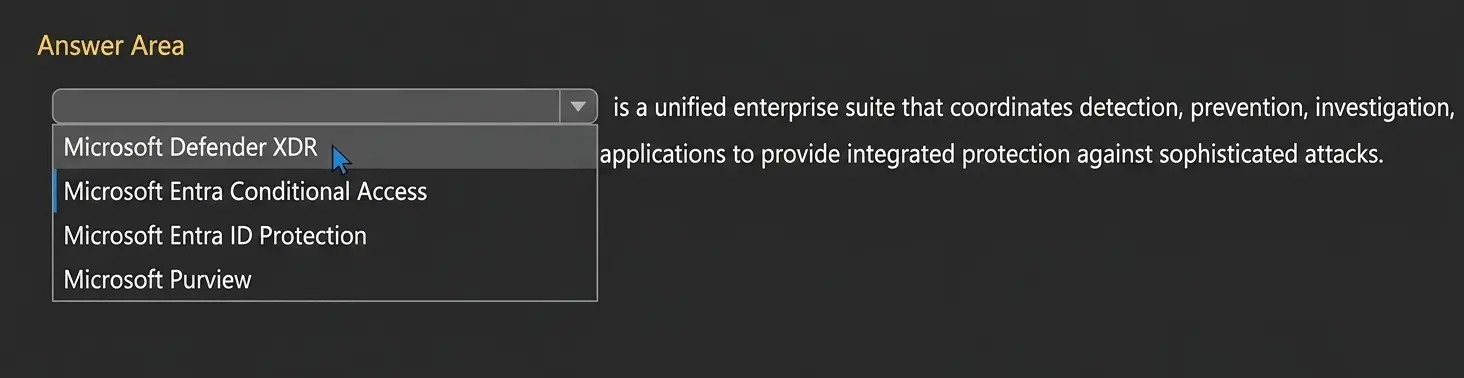
HOTSPOT Select the answer that correctly completes the sentence.
A.

Correct Answer: A
Explanation:
The correct answer is Microsoft Defender XDR. Microsoft Learn defines Microsoft Defender XDR as a unified pre- and post-breach enterprise defense suite that natively coordinates detection, prevention, investigation, and response across endpoints, identities, email, and applications to provide integrated protection against sophisticated attacks. That wording matches the sentence in the question almost exactly, which makes this the clearly correct choice. The other options do not fit that definition. Microsoft Entra Conditional Access is Microsoft’s Zero Trust policy engine used to evaluate signals and enforce access policies, not a cross-domain threat detection and response suite. Microsoft Entra ID Protection focuses on detecting and responding to identity risks such as risky sign-ins and risky users. Microsoft Purview is Microsoft’s portfolio for data governance, data security, and compliance. None of those products is described by Microsoft as coordinating detection, prevention, investigation, and response across endpoints, identities, email, and applications in the same integrated XDR manner. Therefore, the only answer that correctly completes the sentence is Microsoft Defender XDR.
Question #2 (Topic: demo questions)
Your organization has a Microsoft 365 subscription. Which two tasks can you perform by using the Exchange admin center? Each correct answer presents part of the solution. NOTE: Each correct selection is worth one point.
Correct Answer: A, D
Explanation:
The correct answers are A and D because both tasks are supported directly in the Exchange admin center (EAC). Microsoft Learn states that administrators can manage mail flow rules in Exchange Online from the EAC under Mail flow > Rules, which includes creating and managing transport rules for organizational email handling. Microsoft Learn also states that administrators can create shared mailboxes in the EAC under Recipients > Mailboxes, where a shared mailbox can be added and then delegated to users. Option B is incorrect because adding a custom domain is normally done in the Microsoft 365 admin center, specifically on the Domains page. Although Exchange can later work with accepted domains and related mail flow settings, the act of adding and verifying a custom domain is not an Exchange admin center task. Option C is incorrect because license assignment is handled through Microsoft 365 or Microsoft Entra administrative tools, not the Exchange admin center
Question #3 (Topic: demo questions)
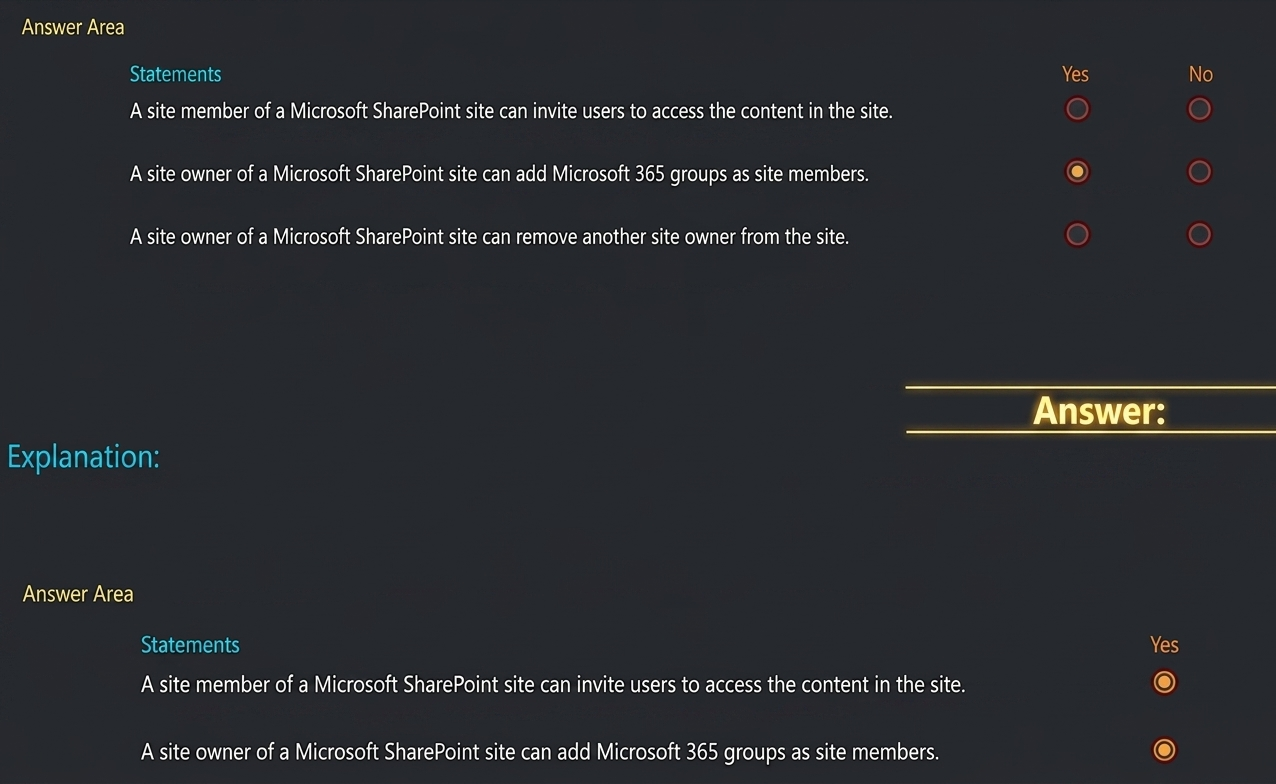
HOTSPOT
Chose the answer
A.
Correct Answer: A
Explanation: