Microsoft AI-300 - Operationalizing Machine Learning and Generative AI Solutions (beta) Certification Exam
Question #1 (Topic: demo questions)
You manage an Azure Machine learning workspace. You develop a machine learning model. You must deploy the model to use a low-priority VM with a pricing discount. You need to deploy the model. Which compute target should you use?
Correct Answer: B
Explanation:
Question #2 (Topic: demo questions)
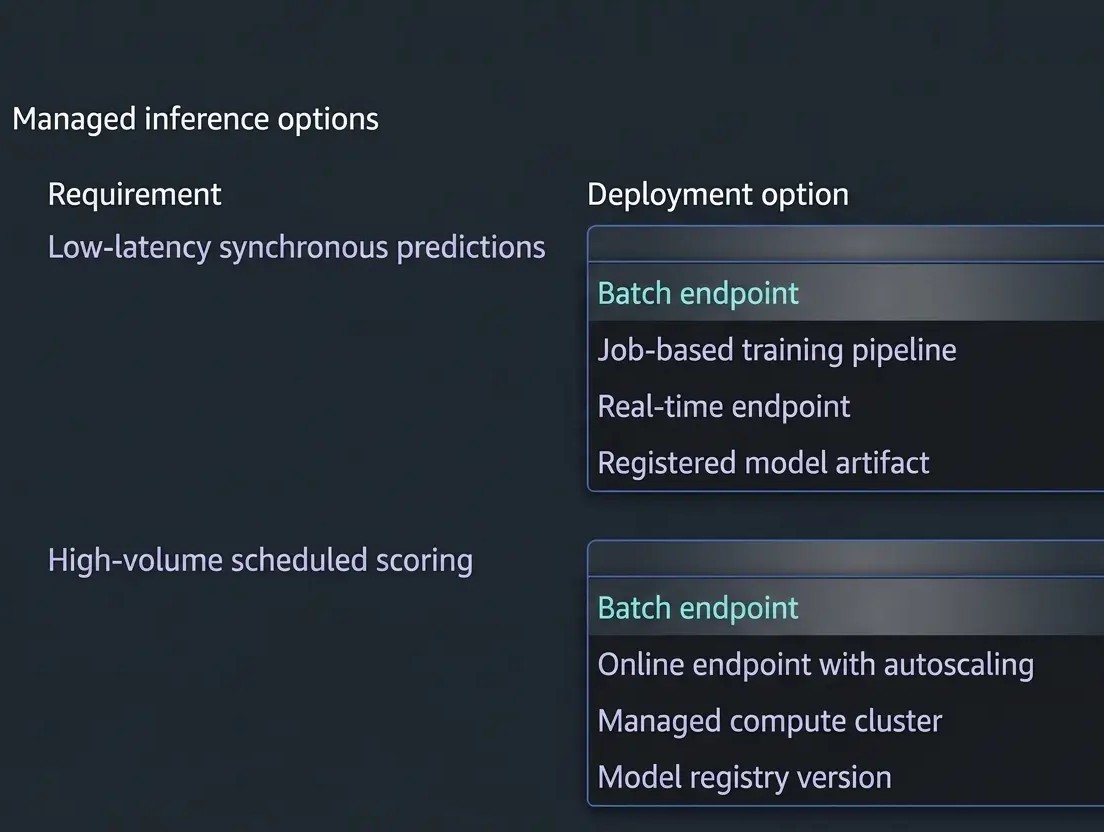
A team trains an MLflow model that scores customer churn risk. The model will be consumed by different downstream systems. One system requests predictions synchronously during customer interactions. Another system submits files containing millions of records for scheduled scoring. You need to deploy the model by using managed inference options that match each usage pattern. Which option should you use for each usage pattern? To answer, select the appropriate options in the answer area. NOTE: Each correct selection is worth one point.
A.
Correct Answer: A
Explanation not available for this question.
Question #3 (Topic: demo questions)
You need to recommend an experiment-tracking strategy that ensures consistent experiment results. What should you recommend?
Correct Answer: B
Explanation:
Question #4 (Topic: demo questions)
You need to isolate training workloads while remaining cost-aware to address Fabrikam Inc.’s issues, constraints, and technical requirements. What should you implement?
Correct Answer: D
Explanation:
Question #5 (Topic: demo questions)
You need to standardize how Fabrikam Inc. manages machine learning assets. Which action should you perform first?
Correct Answer: B
Explanation:
A shared Azure Machine Learning workspace is the foundational step for standardizing how machine learning assets are managed across an organization. The workspace acts as a central environment where datasets, models, environments, pipelines, and compute resources are created, organized, and governed. By establishing a shared workspace first, Fabrikam Inc. ensures that all teams are working within a consistent structure, which enables proper collaboration, access control, and lifecycle management of ML assets.
A shared Azure Machine Learning workspace is the foundational step for standardizing how machine learning assets are managed across an organization. The workspace acts as a central environment where datasets, models, environments, pipelines, and compute resources are created, organized, and governed. By establishing a shared workspace first, Fabrikam Inc. ensures that all teams are working within a consistent structure, which enables proper collaboration, access control, and lifecycle management of ML assets.
Once the workspace is in place, other capabilities—such as registering assets in an Azure Machine Learning registry or deploying managed online endpoints—can be built on top of it. Without a standardized workspace, asset management would remain fragmented and inconsistent, making governance and reuse difficult.