Tableau Desktop-Certified-Associate - Tableau Desktop Certified Associate Certification Exam
Question #1 (Topic: demo questions)
How to add reference lines in a view? (Select correct two answers)
Correct Answer: A, D
Explanation:
Using Analytics pane:
Using Analytics pane: 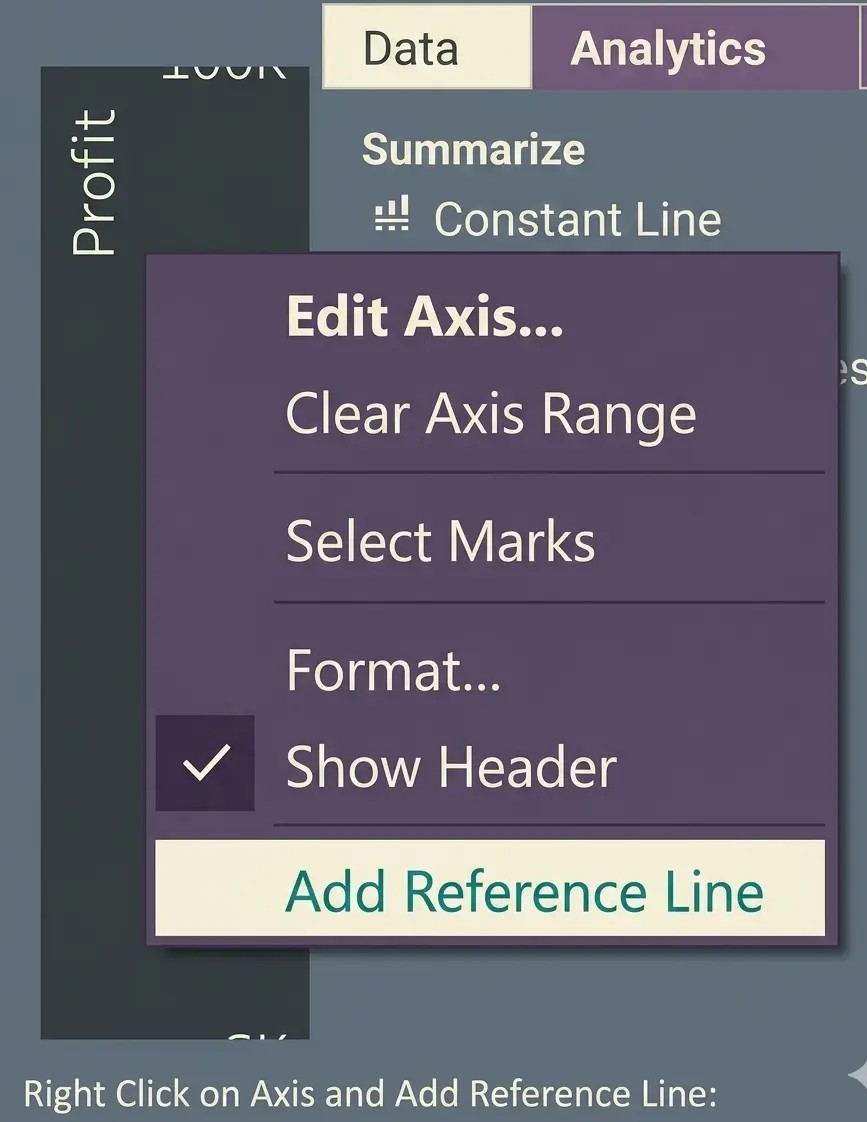
Question #2 (Topic: demo questions)
To create a choropleth map, your data source should include the following types of
information?
Correct Answer: A, B
Explanation:
Question #3 (Topic: demo questions)
How the ATTR() is defined in Tableau?
Correct Answer: A
Explanation:
In Tableau, the ATTR() (Attribute) function is used to return a value when all records in the current level of detail have the same value for a dimension. If there are multiple different values, Tableau displays an asterisk (*) to indicate that the value is not unique. Internally, ATTR() is defined as:
IF MIN([dimension]) = MAX([dimension]) THEN MIN([dimension]) ELSE "*" END
This logic works because if the minimum and maximum values of a dimension are the same, then all values must be identical, so Tableau returns that value. If the minimum and maximum values differ, it means multiple values exist, and Tableau returns an asterisk (*) instead. Therefore, Option A is correct.
IF MIN([dimension]) = MAX([dimension]) THEN MIN([dimension]) ELSE "*" END
This logic works because if the minimum and maximum values of a dimension are the same, then all values must be identical, so Tableau returns that value. If the minimum and maximum values differ, it means multiple values exist, and Tableau returns an asterisk (*) instead. Therefore, Option A is correct.
Question #4 (Topic: demo questions)
In which of the following scenarios you should use the blend?
Correct Answer: C
Explanation:
Union - The data to combine has the same structure but consists of data of different years.